Four numbers anchor this report
2.9%
of scored listings reach Strong tier or above
21.5%
of all active listings disclose a salary range
$205,000
median disclosed remote salary (USD/yr)
918
Europe-region listings ahead of the EU directive
Executive summary
What we observed in the first half of 2026
RemNavi aggregated and structured 8,835 active remote job listings from all the major remote-job boards and ATS career-page feeds (9 platform-level sources, 90+ active feeds) as of 17 May 2026. This report presents the first H1 2026 snapshot of salary disclosure rates, remote-quality scores, employer disclosure behaviour, and a transparency readiness signal ahead of the EU Pay Transparency Directive (Directive 2023/970/EU) effective 7 June 2026.
Five findings:
- The market is polarised, not uniformly weak. Nearly half of scored listings sit in the Weak tier (0–20 RRS) – disclosure of either salary or location is missing. The next-largest band is Solid (40–60), capturing 35.9% of scored listings. Taken together, 38.8% of scored listings show substantive transparency practices; 48.6% show very little. The middle is thin.
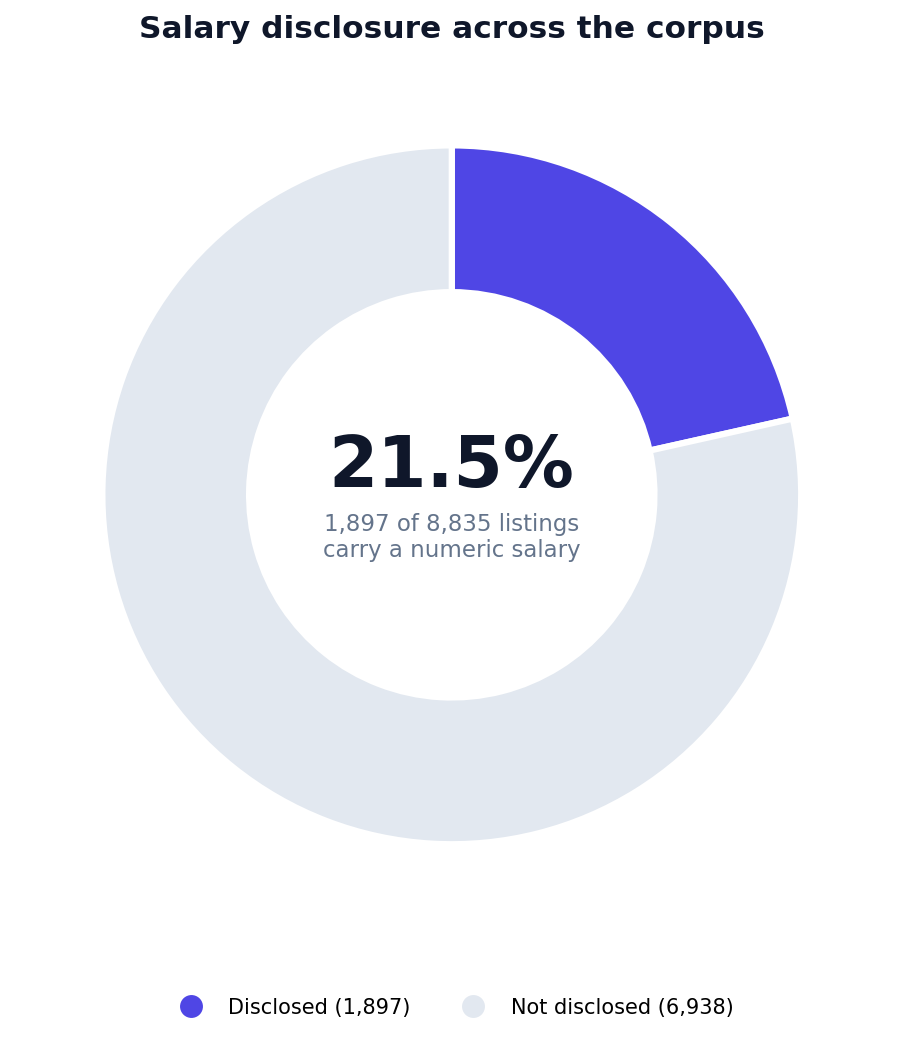
- Salary disclosure remains the exception across the corpus as a whole. Only 21.5% of active listings carry a verifiable numeric range; the other 78.5% rely on free-text compensation language or omit it entirely. The EU Pay Transparency Directive is the largest pending change to this baseline.
- Among employers who disclose, the median remote salary is $205,000 per year (P25 $153,180, P75 $257,000). This figure should be read carefully: the dataset over-represents employers in transparency-mandated jurisdictions. Medians here are a lower-bound signal from disclosing employers, not a market benchmark.
- Engineering and AI roles dominate the disclosed-salary leaderboard. Software Engineering posts the highest listing volume with disclosed bands (326 listings, $237,500 median). Data/ML, smaller in volume, commands the highest median ($242,000) – the AI-product compensation premium is visible in the numbers.
- Europe is still pre-directive. 918 listings in the corpus carry a Europe-region tag; they post a slightly lower average RRS (39) than the overall scored mean (41). The 7 June directive is likely to compress this gap over the next two quarters.
The underlying data is open. Cite as: "RemNavi – State of Remote Hiring 2026 H1." See methodology for full rules.
Known limitations – read before quoting any number
- Disclosure bias: the dataset over-represents employers subject to US state pay transparency law (CA/CO/NY/WA) and EU pre-directive transparency practice (UK, NL, DE).
- Sector bias: SaaS and AI employers are over-represented relative to non-tech sectors.
- Disclosure quality ≠ quantity: a higher disclosure rate driven by enforcement may yield wider posted bands ($100K–$300K) that satisfy directive requirements without improving information value.
- Leaderboard listings counts reflect publicly disclosed bands only – employers with larger overall hiring but lower disclosure rates do not appear.
- Forward-looking statements are signals, not forecasts.
Methodology
How the score is built
The Real Remote Score (RRS) measures how genuinely remote a listing is on a 0–100 scale. The composite is a weighted sum of five pillars.
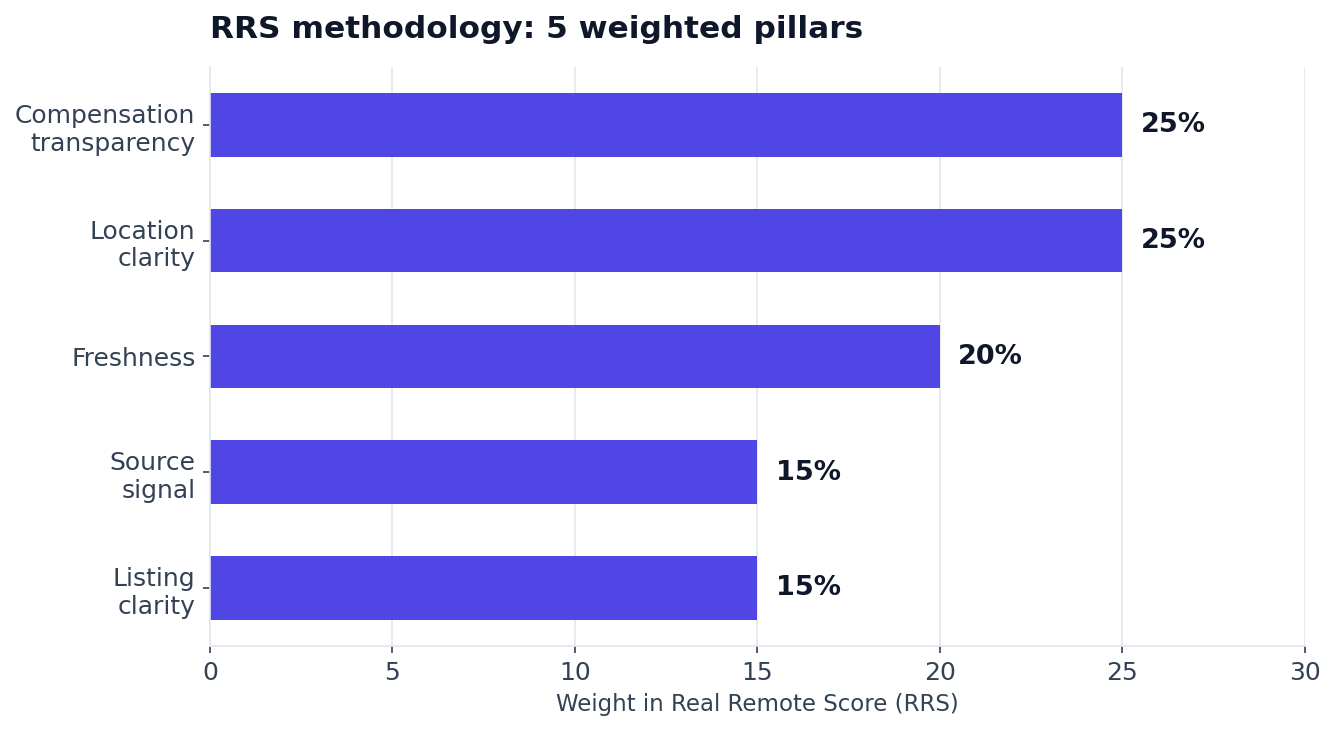
Of 8,835 listings in the May snapshot, 3,495 carry a composite RRS. The remaining 5,340 were ingested but did not yield all five pillar values from the source – typically because the salary band was absent or the location field was free-text and unparseable. They appear in the index without a score and re-enter the scored set as soon as the missing field arrives in a subsequent crawl.
The dataset over-represents employers in transparency-mandated jurisdictions. Treat salary medians as lower-bound signals from disclosing employers, not as universal benchmarks for the full remote market.
Salary disclosure
21.5% disclose. 78.5% don't.
The 78.5% non-disclosing majority is distributed across two patterns: ATS feeds from employers headquartered outside transparency-mandated jurisdictions, and boards that accept free-text language ("competitive", "DOE", "negotiable"). Both are addressable – the first by enforcement, the second by source-side validation.
By role
Disclosed median by role group
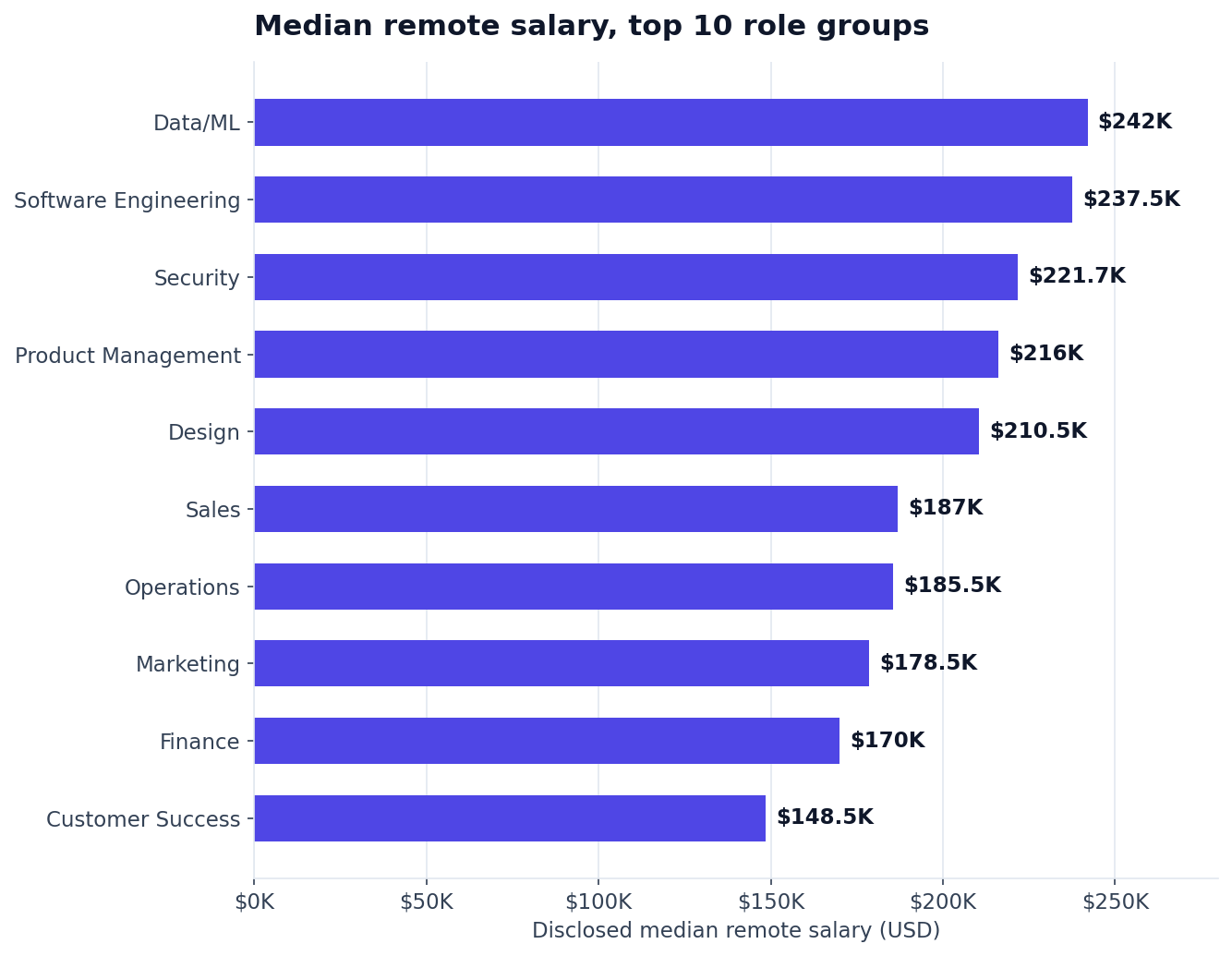
Software Engineering leads volume (326 listings) with a $237,500 median; Data/ML, smaller in volume, commands the highest median ($242,000). The AI-product compensation premium is visible at the role-group level – Data/ML over generalist Software Engineering by roughly $4,500 at the median.
Employer transparency
Top 12 employers by disclosed median
Ranked by median disclosed salary among employers with 10 or more active listings carrying a numeric salary band. Figures are what the employers themselves have published on their public ATS pages.
| # | Employer | Listings | Median | Source |
|---|---|---|---|---|
| 1 | Postman | 19 | $370,000 | Greenhouse |
| 2 | OpenAI | 363 | $291,000 | Ashby |
| 3 | Cloudflare | 32 | $277,500 | Greenhouse |
| 4 | Perplexity | 16 | $260,000 | Ashby |
| 5 | 10 | $237,500 | Greenhouse | |
| 6 | Vercel | 60 | $233,500 | Greenhouse |
| 7 | Figma | 15 | $232,500 | Greenhouse |
| 8 | Render | 18 | $230,000 | Ashby |
| 9 | WorkOS | 27 | $225,000 | Ashby |
| 10 | Airbnb | 19 | $218,000 | Greenhouse |
| 11 | Pendo | 23 | $217,568 | Greenhouse |
| 12 | Vanta | 75 | $212,000 | Ashby |
"Listings" counts positions with a published salary band only. Datadog (396 total listings, average RRS 34) hires more people than most names in the table but discloses less, so it does not appear. Figures reflect publicly disclosed ranges captured during the snapshot window and may not represent final compensation outcomes.
Remote work quality
The transparency pyramid
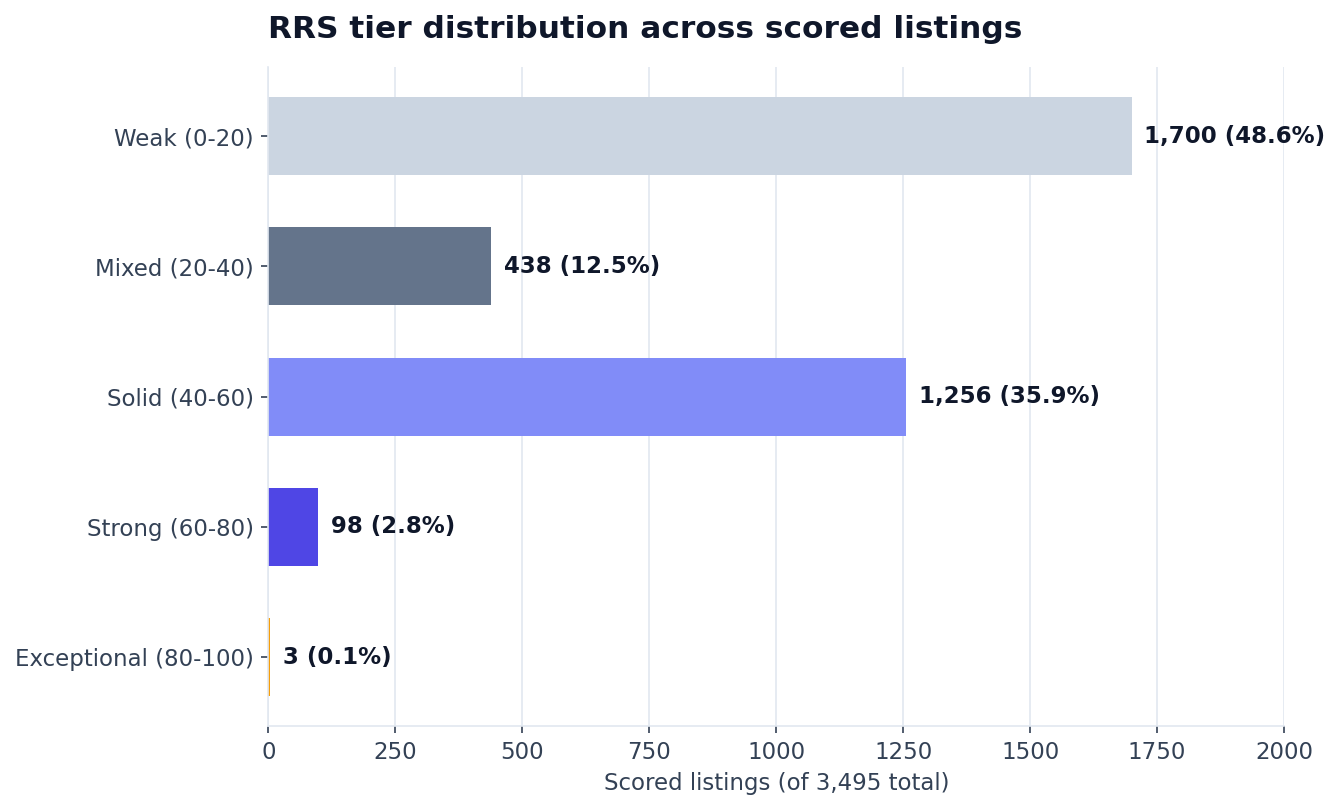
The shape is polarisation, not uniform weakness. Nearly half of scored listings (48.6%) sit in the Weak tier – salary missing or location unparseable. But the next-largest band is Solid (35.9%), where listings disclose substantively, even if a pillar or two falls short. Combined, 38.8% of scored listings show meaningful transparency practices. The middle (Mixed, 12.5%) is thin; very few listings are halfway. Listings tend to either disclose properly or not at all.
A different way to read the same data: 101 listings – 2.9% of the scored set – reach Strong or above on the public 100-point rubric. A small absolute number across a market of 8,835 active remote listings, and an even smaller number measured against the total population of remote roles published anywhere on the web. The 100-point ceiling has been deliberately engineered to be hard to reach. Strong-tier listings are a real signal.
EU Pay Transparency Directive
Transparency readiness signal: what the corpus shows pre-enforcement
Directive 2023/970/EU requires employers with EU operations to disclose salary ranges in job postings and to file gender pay gap reports. It takes effect on 7 June 2026. Employers with 100 or more EU employees face immediate compliance; smaller employers operate under a phased schedule through 2027.
918 listings in our snapshot carry a Europe-region tag – 10.4% of the corpus. Among them, salary disclosure is uneven: employers headquartered in the UK, the Netherlands, and Germany have adopted transparency practices ahead of the deadline, while disclosure is materially lower in most other European markets.
Today's best-disclosing sources by average RRS – Remote OK (63), Greenhouse:Brex (56), Greenhouse:Pendo (57), Ashby:Ramp (53) – are predominantly US-headquartered employers. Their pay transparency is driven by California, Colorado, New York, and Washington state law, not by the EU directive. When the directive takes effect on 7 June, it introduces a new demand for disclosure from European employers, rather than formalising practices they have already adopted.
This section presents a transparency readiness signal – a forward-looking reading of observed disclosure behaviour. It is not a legal compliance assessment.
Geography
Where the listings come from
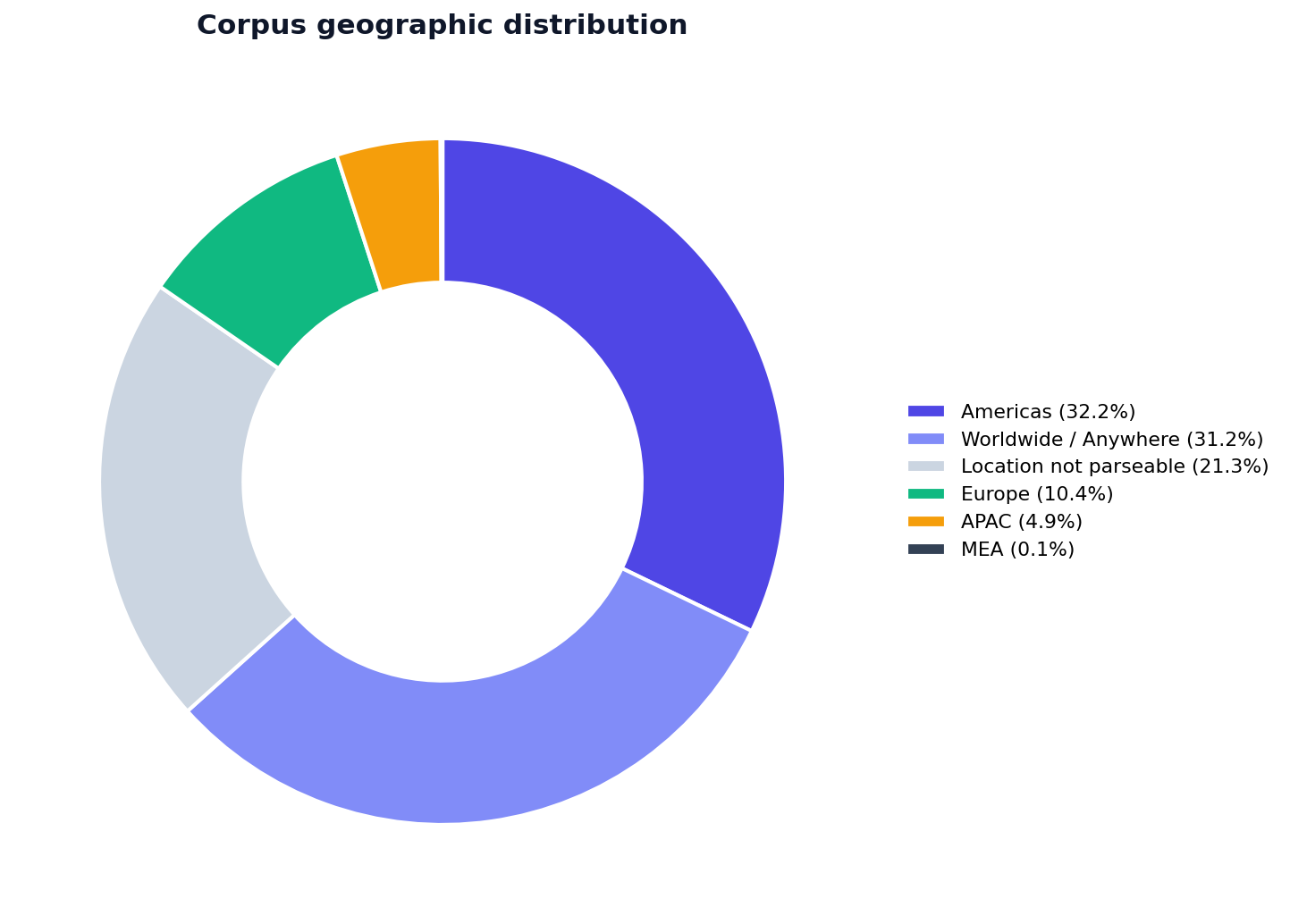
Americas dominates by volume (32.2% of the corpus), reflecting US-headquartered employers who publish bands under state transparency laws. Europe is 10.4% pre-directive; that share is likely to compress upward in H2 as enforcement begins. The "Worldwide / anywhere" bucket (31.2%) is a heuristic classifier output – it includes listings declaring an explicit work-from-anywhere policy plus listings tagged only "Remote" with no further region info. Backend classifier reconciliation shipped 2026-05-18 will split these in subsequent snapshots.
H2 2026 outlook
Three structural tailwinds, three risks
Structural tailwinds.
- The EU Pay Transparency Directive (7 June) is the largest pending shift. Corpus-wide disclosure is likely to rise from 21.5% toward 28–32% within two quarters.
- US state-law expansion continues. California, Colorado, New York, and Washington requirements are near-universally observed among large employers; this baseline is unlikely to erode.
- AI-product compensation signals: OpenAI (363 listings, $291K median) and Perplexity (16 listings, $260K median) appear to be contributing to upward pressure on senior technical pay benchmarks.
Risks and caveats.
- Macro hiring slowdown – corpus volume may decline without a proportional change in disclosure rates; volume and quality metrics will diverge in a contraction scenario.
- Sample bias persists – the corpus over-represents US SaaS and AI employers and under-represents non-tech sectors.
- Disclosure quantity ≠ quality – a higher disclosure rate driven by enforcement may yield wider posted bands that satisfy the letter of a directive without improving information value.
How to cite
- Inline: "RemNavi – State of Remote Hiring 2026 H1." https://remnavi.com/state-of-remote-2026h1/
- Academic / Zenodo: Mező, D. (2026). RemNavi State of Remote Hiring 2026 H1: Salary Disclosure, Remote Quality, and EU Pay Transparency Directive Readiness (Version 1.0) [Report]. Zenodo. https://doi.org/10.5281/zenodo.20322848
- Journalistic: "According to RemNavi, which indexes ~8,800 remote job listings across the major boards and ATS feeds, …"
All citations are welcome under CC BY 4.0. No prior contact required; we ask only that the methodology page be linked where space allows.
Corrections policy
Substantive corrections are added to the report's revision history (see metadata at the top of the PDF) and noted in the public log at /editorial/corrections/. If you spot a factual error or a number that does not reconcile to live data, email press@remnavi.com.
Press kit · Methodology · Methodology versions · Market Notes · Live trends · Dataset JSON · PDF download